Staff augmentation services help US companies add skilled software engineers, QA specialists and designers to their existing teams without the months it usually takes to hire full-time. Startups, SaaS businesses and enterprises use this model to close skill gaps, meet product deadlines and scale capacity up or down as demand changes, while keeping day-to-day control of the work in their own hands.
If you are weighing staff augmentation against hiring in-house or outsourcing an entire project, this guide covers how the model works, where it fits best, how pricing usually works, what to look for in a provider, and how to start with a partner who can deliver.
What Are Staff Augmentation Services?
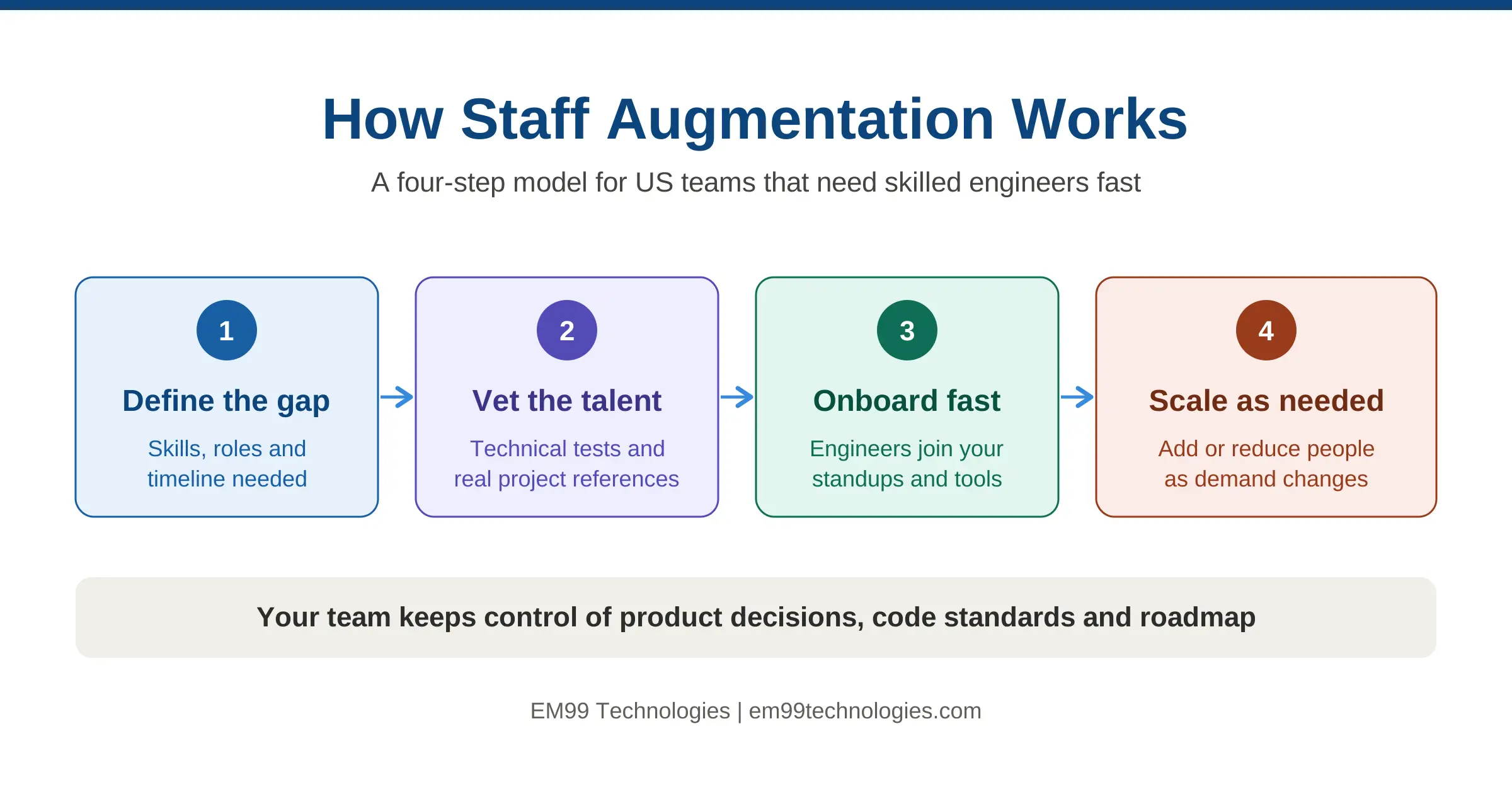
Staff augmentation is a hiring model in which a company brings external specialists in to work alongside its internal team. The provider finds, vets and supplies the engineers, and those engineers join your standups, use your tools and follow your roadmap. Unlike a fixed-scope project, the client keeps ownership of priorities and architecture, which is why the model suits teams that already know what they want to build.
How the Model Works Day to Day
In most engagements, a US product manager or engineering lead sets priorities, assigns tasks and reviews code. The augmented engineers handle sprints, testing and delivery under that direction. Many providers also supply a delivery lead who manages resourcing, reporting and quality, so the internal team spends less time on coordination and more time on decisions that only it can make.
Why US Companies Are Turning to Staff Augmentation
Hiring senior engineers in the United States is slow and expensive. Competition for experienced developers in cloud, data, AI and mobile remains intense, and a single senior role can stay open for months. Staff augmentation addresses this gap directly. The main benefits include:
- Faster access to specialised skills. Vetted engineers can often start within weeks instead of waiting through a full recruitment cycle.
- Flexible capacity. You can add people for a product launch and step them down once the peak passes, without redundancy processes.
- Predictable cost structure. Engagements are usually billed at a monthly rate per engineer, which is easier to budget for than salaries, benefits, recruitment fees and idle time.
- Retained control. Your team still owns product decisions, code standards and the long-term direction of the platform.
Speed to Hire Versus Speed to Value
Time to hire is only part of the picture. A good augmentation partner also shortens the time before new engineers become productive, because they arrive with a tested onboarding process, a development environment ready to use and experience in similar technology stacks. For a startup racing toward an investor milestone, a team that ships useful work in its first month is worth far more than a perfect candidate who joins four months later.
Common Pain Points Staff Augmentation Can Solve
Most companies that consider augmentation are dealing with one or more of the following problems:
- Growing backlogs because the current team cannot absorb new feature requests without slipping existing commitments.
- Missing expertise in areas such as DevOps, machine learning or mobile performance tuning, where hiring a single specialist is difficult.
- Key-person risk when one or two senior developers hold too much of the system’s knowledge in their heads.
- Delayed launches that push revenue or funding milestones back by a quarter or more.
Each of these problems has a practical fix. Augmented engineers add capacity immediately, bring specialised skills into the team and reduce dependency on individuals when pairing, documentation and code reviews are part of the delivery model. The result is a team that can move faster without carrying permanent headcount it may not need a year from now.
Staff Augmentation Compared with Other Hiring Models
Staff augmentation is not the right answer for every situation. The table below compares it with in-house hiring and project outsourcing so you can see where each option fits best.
| Factor | In-house hire | Staff augmentation | Project outsourcing |
| Time to start | Often several months | Days to a few weeks | Depends on scoping |
| Control over work | Full | High, managed by your team | Limited, provider-led |
| Cost structure | Salary, benefits and overhead | Monthly rate per engineer | Fixed or milestone-based |
| Scaling up or down | Slow and costly | Fast | Moderate, change requests needed |
| Best fit | Long-term core roles | Skill gaps and capacity peaks | Clear, self-contained projects |
As a rule of thumb, hire in-house for core leadership and long-term product ownership, use augmentation to fill skill gaps and handle capacity peaks, and consider project outsourcing when the scope is clear, self-contained and unlikely to change much.
Staff Augmentation Pricing Models Explained
Pricing for staff augmentation usually follows one of three structures. Dedicated monthly engineers suit long-term roadmaps, where you pay a fixed rate per person for an agreed period. Time-and-materials billing suits work with variable scope, because you pay for the hours actually spent. Sprint-based pricing suits defined deliverables, with a set cost for each two-week cycle.
Each structure involves trade-offs between predictability and flexibility. Before you agree on terms, discuss how scope changes are handled, what notice period applies if you need to reduce the team and whether there are minimum commitments. Clear answers to these questions prevent most billing disputes later.
How to Choose the Right Staff Augmentation Partner
Provider quality varies widely, and the lowest hourly rate rarely produces the best outcome. These are the factors that matter most when you compare options:
- Vetting process. Look for technical assessments, real project references and clear criteria for senior, mid-level and specialist roles.
- Engineering standards. Ask about code reviews, automated testing, documentation and security checks built into every sprint.
- Communication model. Confirm how often you will receive updates, who your point of contact is and how quickly questions are answered.
- Time zone coverage. Overlap hours with your US team matter for standups, reviews and urgent fixes.
- Contract clarity. Intellectual property ownership, confidentiality and exit terms should be written down before work begins.
Questions to Ask Before You Sign
Before you commit, ask a potential partner how they handle onboarding, what happens if an engineer leaves mid-project and how they measure delivery. Strong providers answer these questions specifically and back their answers with examples from past work. Vague responses are often an early warning sign that the process is not as mature as the sales pitch suggests.
Industries That Benefit Most from Augmented Teams
Staff augmentation works across sectors, but some industries feel the benefit sooner. Healthcare companies often need engineers who understand privacy requirements and clinical workflows, especially when building patient portals or telehealth tools. FinTech firms need specialists in payments, customer onboarding and compliance-heavy reporting, where mistakes are costly.
Logistics and retail businesses rely on dependable systems for tracking, order management and customer portals, and they often need extra hands during peak seasons. Startups and SaaS companies benefit from being able to test an MVP with a small, skilled team before committing to a larger build. In each case, the advantage is the same: capacity and expertise arrive when the business needs them.
How EM99 Technologies Supports US Companies
EM99 Technologies provides resource augmentation for start-ups, SaaS companies and enterprises across the United States, the UK and the Gulf. Our engineers work inside your existing workflows. We combine AI-accelerated development tools with rigorous code reviews and clear weekly reporting, so your team can see progress every week rather than waiting for a final demo.
Our senior leadership stays hands-on with every engagement, and you will always know who owns the outcome. Across our delivery work we track a 98% on-time sprint delivery rate and operate with more than 40 technologies in-house, from React and Node.js to Python, AWS and Flutter. Our team works across time zones and can set overlap hours that suit your US schedule.
Our work for a US telehealth business shows how this plays out in practice. The team built a complete telemedicine and clinic management platform that is now live and in use by clinics across the USA and Canada. You can read more in our client case studies. If your roadmap needs a broader engineering partner, our custom software development services cover the full product lifecycle.
How to Get Started with Staff Augmentation
Getting started does not need to be complicated. Begin by listing the specific skills and roles you need, along with the time frame and the output you expect. Next, share your current tech stack and any existing documentation, so the provider can match engineers to your environment rather than to a generic profile.
Then run a short trial or pilot sprint to measure code quality, communication and speed. If the results meet your expectations, scale the team gradually, adding roles as priorities become clearer. This approach keeps risk low and gives you real evidence before you increase your commitment.
Frequently Asked Questions About Staff Augmentation Services
Is staff augmentation cheaper than hiring in-house?
It can be, once you account for recruitment fees, salaries, benefits, equipment and the time your managers spend on hiring. The real saving comes from paying only for the capacity you need, for as long as you need it. The exact comparison depends on role seniority, location and project length.
How quickly can an augmented team start?
Timelines vary by role and provider, but a well-prepared partner can usually begin within a few weeks. Starting faster depends on clear requirements, access to your tools and a named person on your side who can answer questions quickly.
Can staff augmentation teams work in US time zones?
Yes, if the provider builds overlap hours into the engagement. Shared stand-ups, daily written updates and a clear escalation path keep distributed teams aligned without requiring everyone to work the same hours.
Who owns the code and intellectual property?
In a properly structured engagement, the client owns the bespoke code and agreed deliverables once contractual obligations are met. Ownership, licensing, repository access and handover should be defined in writing before work begins.
Final Thoughts on Staff Augmentation Services in the USA
Staff augmentation services give US companies a practical way to move faster, close skill gaps and scale engineering capacity without a long hiring cycle or the commitment of permanent headcount. The model works best when you keep product ownership in-house, choose a partner with transparent processes and set clear expectations from day one.