B2B software development services in the UK cover the planning, design, engineering, integration and long-term support of custom digital products built for businesses rather than consumers. They include internal platforms, client portals, workflow automation, API integrations, cloud infrastructure and AI-powered tools. For UK companies, the main attraction is access to experienced engineers and a proven delivery process, without the cost, delay and risk of building a full in-house team from scratch. Demand is growing. IMARC estimates the UK outsourced IT services market was worth around USD 26.7 billion in 2025 and forecasts growth of roughly 8% a year through 2034.
If your operations still depend on spreadsheets, disconnected tools or a legacy platform that slows every release, you are not alone. Many founders, operations directors and product managers know exactly what they need but struggle to find the technical capacity to build it. This guide explains what B2B software development services involve, the problems they solve, how to evaluate a partner and what a well-run engagement looks like from start to finish.
What Are B2B Software Development Services
In simple terms, B2B software development is the work of designing and building software that helps one business run better, sell better or serve its own customers better. Unlike off-the-shelf products, these solutions are shaped around your processes, your data and your users. A capable provider handles the full lifecycle, from discovery and architecture through to testing, launch and continuous improvement. Many projects begin with a focused custom software development engagement and then expand as the business gains confidence in the product.
Custom Business Applications
Custom applications replace manual, paper-based or email-driven processes with tailored systems. Typical examples include quoting tools, order management portals, field service apps and internal dashboards that pull data from several sources into one clear view. The benefit is not just efficiency. Staff spend less time chasing information, and managers can act on figures that are accurate and up to date.
Integrations and API Development
Most UK businesses run a mix of CRM, accounting, ERP and industry-specific tools that were never designed to work together. Integration work connects these systems so information flows automatically between them. This reduces duplicate data entry, cuts the errors that come with it and gives leadership a single source of truth for reporting.
AI and Data Solutions
AI features such as intelligent search, document processing, demand forecasting and customer support assistants are increasingly part of B2B product roadmaps. The most successful projects start with a specific business problem and apply AI only where it makes the product genuinely better. Our own AI/ML solutions practice follows that principle, focusing on measurable outcomes rather than novelty.
Why UK Companies Are Investing in External Development Capacity
Hiring experienced software engineers in the UK is slow and expensive. Recruitment cycles can stretch for months, and salaries for specialist skills such as cloud architecture, data engineering and mobile development continue to rise. Partnering with an external team has become a mainstream response to these pressures, and it is no longer seen as a fallback option.
The trend is visible in the research. The CBI has reported that 35% of the UK’s top IT-spending organisations were planning to increase their IT outsourcing over the following two years. Separately, industry research compiled by IMARC points to widespread recruitment difficulty, with around 80% of UK businesses reported to struggle to hire technology professionals.
Immigration policy adds another layer of complexity. Analysis in Chambers’ Technology and Outsourcing 2026 guide notes that the UK points-based immigration system has made it harder and more costly for outsourcing providers to recruit overseas staff. That makes it even more important to choose a partner with a stable, well-managed team rather than one that relies on constant hiring to keep projects moving.
Common Pain Points B2B Companies Face
Most engagements begin with one or more of the problems below. If any of them sound familiar, a dedicated software development partner may be able to help.
- Slow release cycles. Features that should take weeks take months because the internal team is stretched across support, maintenance and new development at the same time.
- Fragmented systems. Data sits in separate tools, so reporting is manual and leadership makes decisions based on incomplete information.
- Legacy platforms. Ageing codebases are hard to change, expensive to maintain and increasingly exposed to security vulnerabilities.
Security deserves special attention. Any software that processes personal data must comply with UK GDPR, and a responsible provider should be able to explain how data is protected, who can access it and how it is returned or deleted at the end of a contract. Asking these questions early protects your customers and your reputation, and it saves costly rework later.
Building In-House, Outsourcing or Augmenting Your Team
There is no single right answer to how software should be delivered. The best model depends on how much control you need, how long the work will last and how much technical knowledge already exists inside the business. The table below compares the three most common approaches so you can see where each one fits.
| Factor | In-house team | Full development partner | Staff augmentation |
| Time to start | Often several months to recruit | Typically within weeks | Typically within weeks |
| Cost model | Salaries, benefits and overheads | Scoped project or retainer | Monthly rate per engineer |
| Control over delivery | Full, managed internally | Shared, with agreed governance | Full, using your own managers |
| Scalability | Slow to adjust | Flexible across project phases | Flexible, engineer by engineer |
| Best suited to | Long-term core product teams | End-to-end builds and modernisation | Filling skill gaps in an existing team |
Key Benefits of Professional B2B Software Development
When the right partner is chosen, the advantages go well beyond writing code. The following benefits are the ones decision makers mention most often after a successful engagement.
Faster Time to Market
An experienced partner brings proven processes, reusable components and a team that has solved similar problems before. That usually means a usable first version reaches real users sooner, which allows you to test assumptions with genuine feedback rather than guesswork. Getting to market earlier can be the difference between leading a category and chasing it.
Access to Specialist Skills
Few businesses need a full-time specialist in every technology they use. With a partner, you can draw on experts in mobile app development, cloud infrastructure, cybersecurity, UI and UX design and AI, bringing in each skill only when the project requires it. This keeps your fixed costs low while still giving you depth where it matters.
Predictable Costs and Clear Ownership
Scoped proposals, agreed milestones and transparent reporting make budgets easier to plan and defend internally. Reputable providers also clarify who owns the source code, what documentation you will receive and how the product will be supported after launch. These terms should be written down clearly before work begins.
How a Structured Delivery Process Reduces Risk
Many software projects struggle not because of poor coding, but because requirements were unclear or feedback arrived too late to matter. A structured delivery process addresses both problems and gives stakeholders visibility at every stage.
Discovery and Roadmapping
Strong projects start with questions. What problem are you solving? Who will use the product? Which measures will show that it is working? A discovery phase turns those answers into a prioritised roadmap, a realistic estimate and a clear list of assumptions and exclusions. It is the stage that prevents most budget surprises later.
Agile Delivery in Short Sprints
Work is usually organised into short sprints, often two weeks long, with regular demonstrations of working software. This keeps stakeholders involved, makes priorities visible to everyone and allows changes to be made early, when they are cheap to make, rather than late, when they are expensive.
Testing, Launch and Ongoing Support
Quality assurance, security checks and performance testing should happen throughout the build, not only at the end. After launch, monitoring, updates and a roadmap for improvements keep the product reliable and competitive. A good partner plans this support model before go-live, including response targets and reporting.
How to Choose the Right B2B Software Development Partner
Once you understand what you need, the next step is evaluating providers. Portfolios and price matter, but they do not tell the whole story. Use the following checklist when you speak with potential partners and listen closely to how they answer.
- Relevant experience. Ask for case studies in your sector and examples of work for UK clients with similar requirements, rather than relying on a list of logos.
- A transparent process. A good partner explains how discovery, delivery, communication and handover will work before you sign anything.
- Clear security and ownership terms. Confirm how data is protected, who owns the source code and what happens to access and documentation when the contract ends.
Independent reviews and long-term client relationships are also useful signals. Consistent delivery over several years is a more reliable indicator than any single impressive project, so look for evidence of repeat work and sustained trust.
Real-World Examples of B2B Software Delivery
Abstract benefits are easier to judge when you can see real projects. EM99 Technologies, an AI-accelerated software engineering company serving clients across the UK, USA, UAE and Saudi Arabia, has delivered platforms across sectors including healthcare, fintech, logistics and retail. According to the company’s website, it has operated since 2013, holds a 4.5 rating on Trustpilot and reports 98% on-time sprint delivery.
One example is a UK project in which a client operating across several high-risk industries moved safety management from paper-based processes to a real-time digital system. Managers gained live visibility over compliance tasks, and the change replaced a slow manual process with one that could be audited and acted upon quickly.
Another project replaced a patchwork of WhatsApp messages and spreadsheets with a dedicated B2B wholesale platform. Trade customers could place and track orders in one structured place, and the business reduced the manual administration that had been holding back growth. You can explore more examples in our success stories.
Frequently Asked Questions About B2B Software Development in the UK
How much does B2B software development cost in the UK?
Costs vary widely with scope, integrations, data requirements, security needs and the number of user roles involved. A short discovery phase is usually the most sensible starting point, because it produces a scoped estimate with clearly stated assumptions and exclusions. That gives you a realistic budget before committing to a full build.
How long does a B2B software project take?
A focused MVP development project can often reach users within a few months, while complex platforms usually run in phases. Splitting the roadmap into releases that deliver value early keeps momentum high and gives stakeholders something tangible to review throughout the project.
Will we own the source code?
Reputable providers typically transfer ownership of bespoke code and agreed deliverables once contractual obligations are met, subject to any third-party or pre-existing components. The contract should state ownership, licensing and repository access explicitly, so there is no ambiguity later.
Can an outside team work alongside our internal staff?
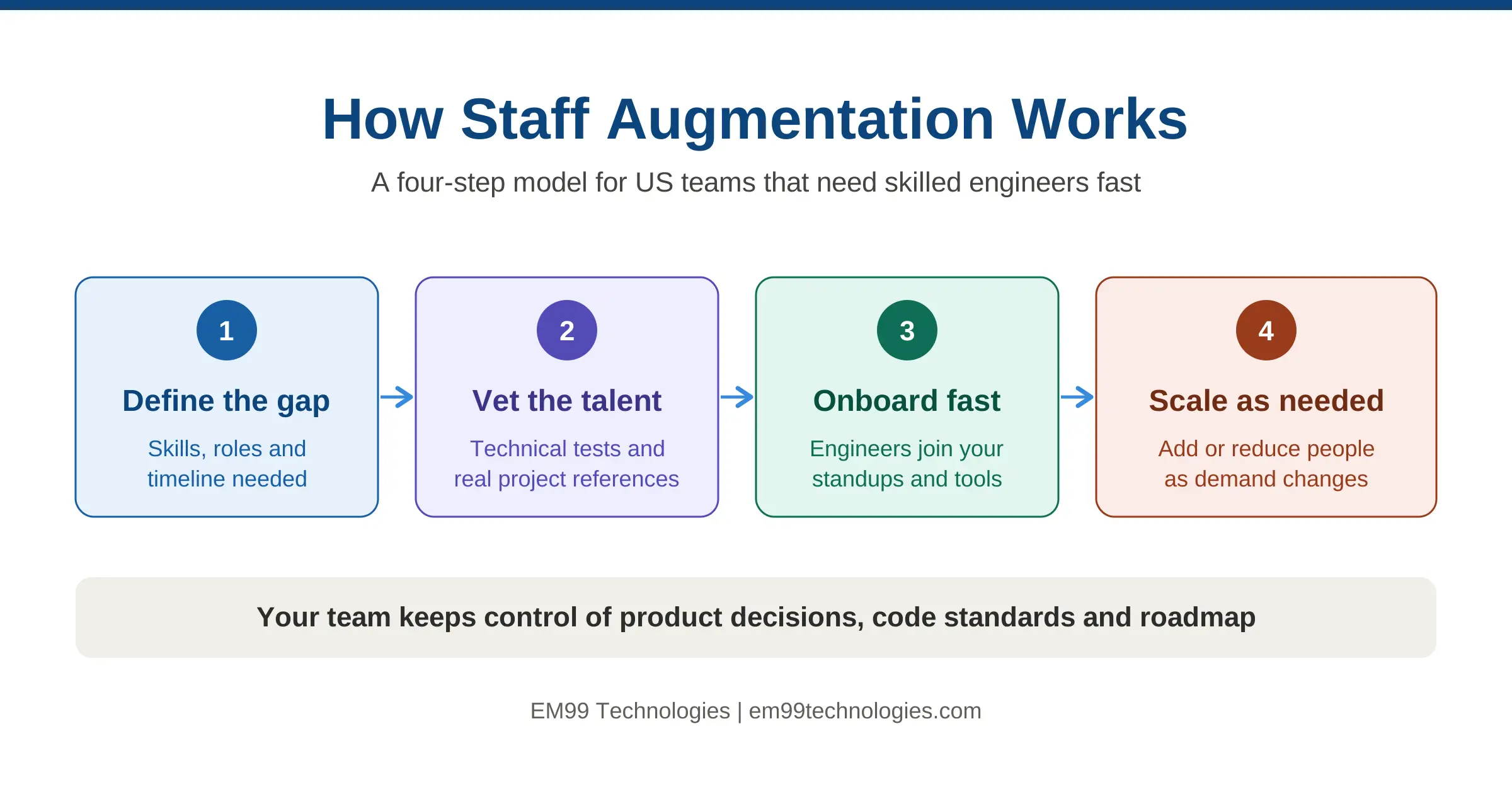
Yes. A partner can take ownership of a defined workstream, supply specialist engineers or form a blended team with your own people. Many businesses use this approach through resource augmentation to close skill gaps quickly. Agreeing on communication, technical standards and decision rights at the outset keeps work from falling between teams.
How do providers protect personal data under UK GDPR?
Data protection should be designed in from the very beginning. That includes role-based access controls, encryption, secure architecture, dependency scanning and clear processor terms where a provider handles personal data on your behalf. Ask for these measures to be documented in the proposal rather than assumed.
Taking the Next Step with B2B Software Development Services in the UK
B2B software development services in the UK can turn slow, fragmented operations into scalable digital products that your team and your customers rely on every day. The right approach starts with a clearly defined problem, a realistic scope and a partner who communicates openly about cost, timelines and risk.
If you are weighing up options for a project, the most useful first step is a conversation. Our team can review your goals, current systems and constraints, then outline practical next steps, whether that is a focused discovery phase or a scoped delivery proposal. For quick answers to common questions, visit our FAQ page.