Data science project development is the end-to-end process of scoping, building, deploying, and maintaining data-driven solutions such as predictive models, forecasting systems, recommendation engines, and analytics platforms. For businesses in the USA and UK, a well-run data science project turns scattered operational data into decisions that reduce costs, grow revenue, or lower risk. EM99 Technologies is an AI-first digital product and engineering company that delivers these projects for clients in banking, fintech, healthcare, telecom, real estate, and government.
Many companies have data but lack the team, process, or infrastructure to use it. This guide explains how data science project development works from start to finish, which business problems it solves best, the pain points that derail projects, and how to choose the right delivery model for your organization.
What Is Data Science Project Development and Who Needs It
Data science project development goes beyond running a model in a notebook. It covers business requirements, data pipelines, model design, testing, integration with existing software, and long-term monitoring. The goal is a system that business users rely on every day, not a one-time analysis that sits in a slide deck.
Business Problems That Call for a Custom Data Science Project
Off-the-shelf tools rarely fit every workflow. Companies usually commission custom development when they need to combine proprietary data, meet specific compliance rules, or embed predictions into their own products. Typical triggers include:
- Revenue leakage from churn, fraud, or pricing errors that spreadsheets cannot catch in time.
- Operational inefficiency in inventory, staffing, logistics, or maintenance planning.
- A product roadmap that needs AI features, such as personalization or automated insights.
The Data Science Project Development Lifecycle
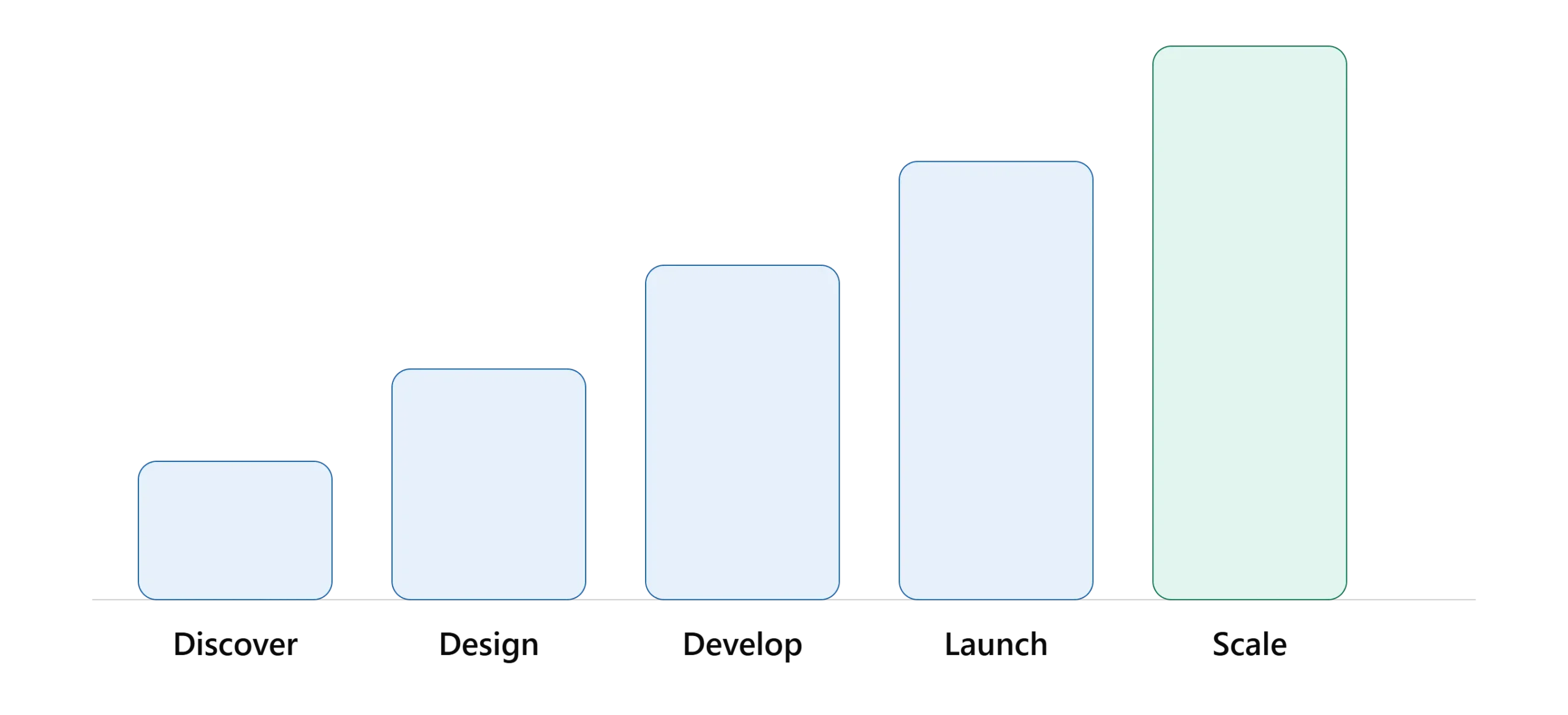
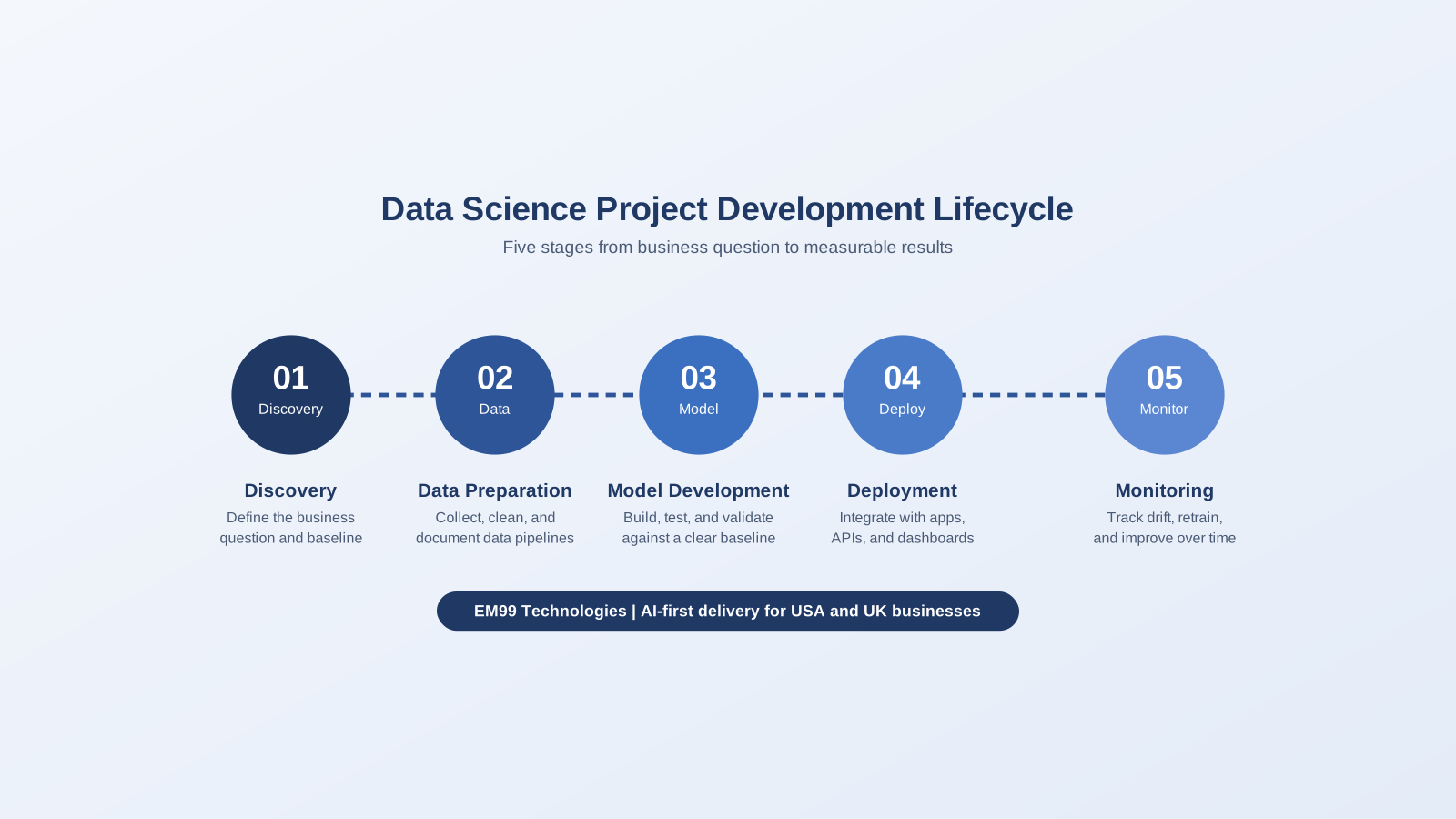
A reliable delivery process reduces risk and keeps stakeholders informed. Most successful projects follow five stages, each with a clear output that the business can review before the next phase begins.
Discovery and Business Requirements
Every project starts with a precise business question. What decision will the model support? Who will use the output? What does success look like in numbers? Defining a baseline at this stage, such as the current churn rate or forecast error, makes it possible to prove the value of the project later.
Data Collection and Data Preparation
Data preparation usually consumes the largest share of project time. Engineers connect source systems, build pipelines, handle missing values, resolve duplicate records, and document every transformation. A clean, well-documented data layer also makes future projects faster.
Model Development and Validation
Teams test several approaches against a clear baseline and choose the one that balances accuracy, speed, and explainability. Validation includes held-out test sets, bias checks, and stress tests on edge cases. Business stakeholders should review results in plain language, including where the model is weak.
Deployment and System Integration
A model creates value only when it reaches users. Deployment connects predictions to dashboards, internal tools, mobile apps, or customer-facing platforms through APIs. Engineers also set up logging, access controls, and rollback plans so that the system can be changed safely.
Monitoring and Continuous Improvement
Data changes over time, and models can drift. Monitoring tracks prediction quality, input data shifts, and business outcomes. Scheduled retraining and periodic reviews keep the solution accurate as customer behavior, markets, and regulations evolve.
Common Data Science Projects Businesses Commission
Certain project types appear again and again across industries. Each one solves a specific problem and has clear measures of success that make it easier to plan a budget and timeline.
Customer Churn Prediction for Subscription Businesses
Churn models identify customers likely to cancel so that retention teams can act early. A strong project connects the model to a CRM, triggers personalized offers, and measures the change in retention rate against a control group. This type of project often delivers visible returns within a single quarter.
Demand Forecasting for Retail and Logistics
Accurate forecasts reduce both stockouts and excess inventory. Development teams combine historical sales, seasonality, promotions, and external signals such as weather or local events. Success is measured by forecast error, inventory holding costs, and fill rates.
Fraud Detection for Banking and Fintech
Fraud systems must catch suspicious transactions quickly while limiting false alarms that frustrate legitimate customers. Projects in this area focus on real-time scoring, imbalanced data handling, and clear audit trails for compliance teams.
Recommendation Engines for E-Commerce
Personalized product recommendations increase average order value and repeat purchases. Development covers user behavior tracking, candidate generation, ranking models, and A/B testing to prove lift before a full rollout.
Generative AI Assistants Over Company Documents
Many organizations want staff to search policies, contracts, or technical manuals in natural language. A retrieval-augmented generation system connects a language model to approved internal documents, with access controls, source citations, and evaluation datasets that check answer quality before launch.
Pain Points in Data Science Project Development and How to Solve Them
Even well-funded projects stall for predictable reasons. Recognizing these pain points early allows business leaders to plan around them rather than react after budgets have been spent.
Poor Data Quality Delays Everything
When source data is incomplete or inconsistent, timelines slip and results lose credibility. Run a data audit during discovery, assign owners for critical data sources, and budget time for cleaning before modeling starts. Clear data contracts between teams prevent many of these delays.
Unclear Success Metrics
A project without a defined target can never be declared successful. Agree on one primary metric, such as reduced churn or lower forecast error, along with supporting metrics like cost and adoption. Write these into the scope document so that every stakeholder evaluates results the same way.
Models That Never Reach Production
A notebook prototype that is never deployed delivers no business value. Plan for integration from the first sprint. Involve the engineers who will maintain the system, and define how predictions will reach end users before the model is built.
Security and Compliance Concerns
Projects in healthcare, banking, and government must meet strict rules, including HIPAA in the USA and UK GDPR in the UK. Address data minimization, encryption, role-based access, and audit logging in the architecture rather than adding them at the end. Involve legal and security teams early so that approvals do not block launch.
In-House Team or Outsourced Data Science Project Development
Businesses often ask whether to build a data science capability internally or work with an external partner. The answer depends on how many projects you expect, how quickly you need results, and how much long-term ownership you want to keep. The comparison below highlights the main differences.
| Factor | In-House Team | Outsourced Development Partner |
| Time to first results | Often slower due to hiring and onboarding | Faster start with a ready team and proven workflows |
| Upfront cost | High, including salaries, tools, and infrastructure | Scoped and budgeted per project or milestone |
| Access to niche skills | Limited to the people you can hire | Cross-functional access to ML, data engineering, and cloud experts |
| Ongoing maintenance | Your team owns everything long term | Can be handled through a managed support agreement |
| Scalability | Depends on recruiting speed | Team size adjusted as the project grows or shrinks |
Many companies choose a hybrid model. An external partner delivers the first projects and transfers knowledge to internal staff, who then take over maintenance. This approach builds capability while avoiding the long hiring cycle that can delay early results.
How EM99 Technologies Approaches Data Science Project Development
EM99 Technologies works as a product and engineering partner rather than a traditional vendor. Our teams combine data science, software engineering, and cloud operations so that a model becomes a working part of your business. We serve clients across the UK, USA, UAE, and Saudi Arabia, and we support projects through AI software development, custom software development, managed IT services, and digital product engineering.
Every engagement follows the same discipline: a scoped discovery phase, measurable milestones, regular stakeholder reviews, and clear handover documentation. Our clients receive:
- A defined success metric agreed before development begins.
- Production-ready code, pipelines, and documentation owned by the client.
- Post-launch monitoring and support options that fit the client’s internal capacity.
Choosing the Right Data Science Development Partner
Selecting a partner is one of the most important decisions in any data initiative. Look beyond technical skills and evaluate how the team works with business stakeholders. Ask for references from projects similar to yours, a clear explanation of how they handle scope changes, and a plan for knowledge transfer. A good partner will also tell you when a simpler solution will do the job.
Frequently Asked Questions About Data Science Project Development
How long does a data science project take?
Timelines depend on data readiness and scope. A focused proof of concept often takes four to six weeks, while a full production system with integrations may take several months. A discovery phase at the start gives a more accurate estimate.
How much does data science project development cost in the USA and UK?
Costs vary with complexity, data volume, compliance requirements, and team size. The most reliable way to get a figure is to share your objectives and available data so that a partner can scope the work and propose a fixed or milestone-based budget.
What data do we need to get started?
You do not need perfect data to begin. Historical records, a list of the systems that hold relevant information, and a clear description of the business decision are usually enough for discovery. The data audit in the first phase will identify any gaps.
Start Your Data Science Project Development With EM99 Technologies
Data science project development works best when business goals, clean data, and skilled engineering come together from the start. Whether you need a churn model, a forecasting system, or a secure AI assistant for internal teams, a structured process will help you reach measurable results faster.
Ready to scope your data science project? Book a free discovery call with the EM99 Technologies team. We will review your objectives, assess your data readiness, and outline a practical development roadmap for your business. Contact EM99 Technologies today and let us start building a solution that delivers measurable value.