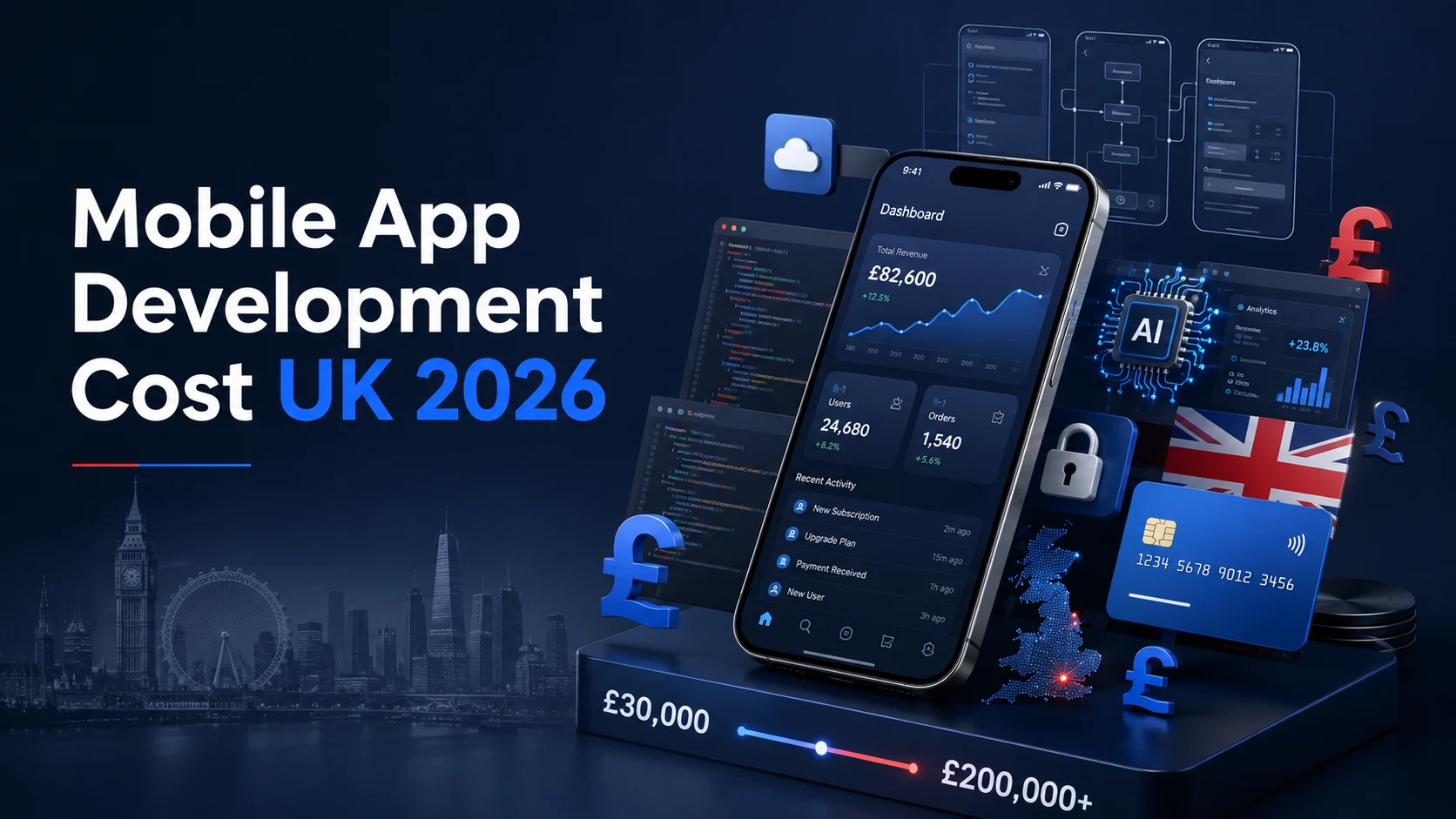
The price of building a mobile app in the UK will typically range from just under £30,000 for a simple, focused minimum viable product (MVP) to well over £200,000 for a more complex, high-stakes or regulated platform. It’s unlikely that two apps of the same screen number will be priced anywhere near the same. Ultimately, when you ask, “How much does it cost to build a mobile app?” It’s not the number of screens that dictates the price; it’s what’s happening behind them that matters.
Mobile apps involving user accounts, payment gateways, real-time location tracking, video streaming, machine learning, third-party integrations or back-end administration and data security tools will naturally require a greater level of effort across design, development and testing.
In their UK pricing guidelines, Clutch states that feature-light and MVPs typically cost £30,000 to £80,000. Mid-complexity apps featuring integrations or payments may cost between £80,000 and £200,000. Enterprise or regulated applications usually start from over £200,000. GoodFirms puts the figure even higher, giving a potential global range from approximately £15,000 ($15,000) up to £500,000 ($500,000) or higher, which is an indication of the gap between a basic app and a complex, regulated or AI-driven piece of software.
For all such estimates, these should be seen as planning benchmarks. For a firm quotation, you’ll need to define the app’s users, core functions, platforms, technical constraints, and the specific business goals it’s intended to achieve.
What Is the Average Mobile App Development Cost in the UK?
A professional mobile app project in the UK will usually fall into one of the following categories:
| App complexity | Typical features | Estimated UK cost in 2026 |
| Feature-light app | Static content, forms, basic navigation and limited data storage | £20,000-£40,000 |
| Startup MVP | One main user type, login, profiles, one core service and a basic backend | £30,000-£80,000 |
| Mid-complexity app | Payments, notifications, dashboards, subscriptions and integrations | £80,000-£200,000 |
| Complex platform | Multiple user roles, real-time data, advanced administration and automation | £150,000-£300,000+ |
| Enterprise or regulated app | Complex infrastructure, high security, compliance, scalability and legacy integrations | £200,000-£500,000+ |
The ranges above combine current UK agency pricing benchmarks with wider 2026 industry research. The final price will depend on the exact project scope, delivery team and technical approach.
Clutch’s broader 2026 data shows an average reviewed app development project cost of approximately $90,780, with an average delivery period of around 11 months. However, that figure covers projects from several countries and should not be treated as a fixed UK average.
Mobile App Development Cost by App Type
The type of product being developed also affects the budget. The following figures are practical UK planning estimates based on current UK development rates and international category-level cost research.
| Type of mobile app | Estimated 2026 UK cost |
| Informational or content app | £20,000-£45,000 |
| Appointment or booking app | £35,000-£90,000 |
| Subscription or membership app | £45,000-£120,000 |
| E-commerce app | £50,000-£180,000 |
| Restaurant or food-ordering app | £60,000-£160,000 |
| Delivery or on-demand service app | £80,000-£220,000 |
| Marketplace app | £80,000-£250,000 |
| Social networking or community app | £100,000-£300,000 |
| Fintech or banking app | £150,000-£400,000+ |
| Healthcare or telemedicine app | £150,000-£400,000+ |
| AI-powered mobile app | £100,000-£350,000+ |
| Logistics or IoT application | £120,000-£350,000+ |
| Enterprise workforce application | £150,000-£500,000+ |
| Mobile game | £50,000-£300,000+ |
An app’s category does not determine its cost on its own. A basic e-commerce app using an established platform may cost less than a highly customised booking system with complicated scheduling rules.
GoodFirms estimates that e-commerce apps can range from around $40,000 to $250,000 globally, while apps using technologies such as AI, blockchain, IoT or augmented reality can range from approximately $50,000 to $400,000 or more.
Estimated Mobile App Development Costs from 2026 to 2033
No reliable source can guarantee what an app will cost in 2033. Technology, developer productivity, AI-assisted coding, regulation and labour rates may all change before then.
The following table is therefore an illustrative budgeting projection, not a confirmed market-price forecast. It applies a 3% annual increase to current UK cost bands while keeping the project scope unchanged.
The Office for Budget Responsibility expects UK CPI inflation to remain close to the 2% target over its forecast period. The additional allowance in this projection provides a modest buffer for specialist development skills, security requirements and technical complexity.
| Year | Feature-light app or MVP | Mid-complexity app | Enterprise or regulated app |
| 2026 | £30,000-£80,000 | £80,000-£200,000 | £200,000-£500,000 |
| 2027 | £31,000-£82,000 | £82,000-£206,000 | £206,000-£515,000 |
| 2028 | £32,000-£85,000 | £85,000-£212,000 | £212,000-£530,000 |
| 2029 | £33,000-£87,000 | £87,000-£219,000 | £219,000-£546,000 |
| 2030 | £34,000-£90,000 | £90,000-£225,000 | £225,000-£563,000 |
| 2031 | £35,000-£93,000 | £93,000-£232,000 | £232,000-£580,000 |
| 2032 | £36,000-£96,000 | £96,000-£239,000 | £239,000-£597,000 |
| 2033 | £37,000-£98,000 | £98,000-£246,000 | £246,000-£615,000 |
These projections show what the same general project might cost if prices rise gradually. They do not include additional features, changes in regulation or a major expansion in the number of users.
AI-assisted development may reduce the time required for some routine tasks. At the same time, demand for AI features, advanced cybersecurity, data governance and personalised user experiences may increase the overall scope of future applications.
What Factors Influence Mobile App Development Cost?
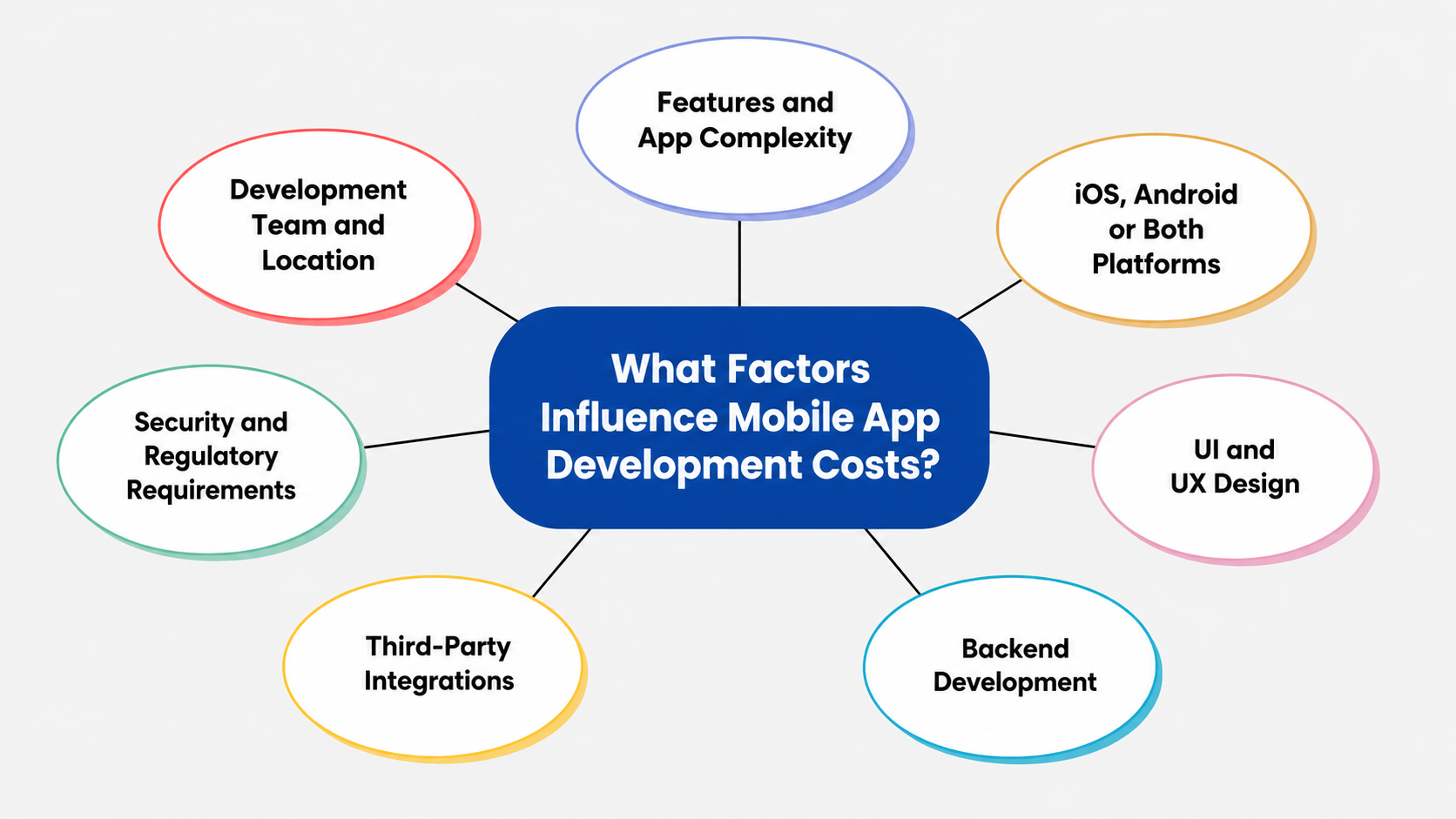
1. Features and App Complexity
Features are usually the biggest influence on the final budget.
A straightforward application containing information, contact forms and limited user accounts will require less work than a marketplace connecting customers, vendors, drivers and administrators.
Features that commonly increase costs include:
- Online payments and subscriptions
- Live location tracking
- Real-time messaging
- Video and audio calls
- Artificial intelligence
- Biometric authentication
- Multiple user roles
- Document verification
- Offline functionality
- Advanced search and filtering
- Personalised recommendations
- Integration with existing business software
Businesses should also consider the administration system behind the app. Even when customers only see a mobile interface, the company may need a web-based dashboard to manage users, orders, payments, content, reports and notifications.
2. iOS, Android or Both Platforms
Creating a native iOS application and a separate native Android application normally requires two codebases. That means more development, testing and long-term maintenance.
Clutch notes that hourly rates may be similar across Android, iOS and cross-platform projects, but building separate native apps can significantly increase the total cost because they operate as two separate development projects.
Cross-platform frameworks such as Flutter and React Native allow developers to reuse a large portion of the code across iOS and Android. This can make cross-platform development suitable for MVPs, e-commerce apps, booking platforms and many business applications.
Native development may still be the better option when an application depends heavily on advanced device functions, intensive graphics, low-level hardware access or platform-specific performance.
em99 technologies develops both native and cross-platform mobile applications using technologies including Flutter and React Native.
3. UI and UX Design
Mobile app design involves more than selecting colours and creating attractive screens.
A complete UI and UX process may include:
- User research
- Competitor analysis
- User journey mapping
- Wireframes
- Interactive prototypes
- Usability testing
- Accessibility reviews
- Responsive layouts
- Design-system creation
An interface that uses familiar mobile patterns will generally cost less than a fully customised experience containing advanced animations, illustrations and interactive transitions.
Investing in UX early can also prevent expensive changes later. It is usually cheaper to identify a confusing user journey in a prototype than after the application has already been coded.
4. Backend Development
Most professional applications require a backend system.
The backend may be responsible for:
- Storing user information
- Processing payments
- Managing accounts
- Sending notifications
- Running business rules
- Connecting to external services
- Producing reports
- Synchronising data between devices
The cost will rise when an application requires real-time updates, complex databases, high user volumes, automated workflows or integration with older business systems.
5. Third-Party Integrations
Using existing services can reduce development time, but these services may introduce setup work and ongoing charges.
Common integrations include:
- Stripe or PayPal
- Google Maps
- Open Banking services
- Identity-verification providers
- Customer relationship management systems
- Artificial-intelligence APIs
- Cloud storage
- Email and SMS services
- Analytics platforms
- Delivery-management systems
Businesses should check whether third-party licensing and usage fees are included in the initial quotation.
6. Security and Regulatory Requirements
The security needs to be designed at the very start of the project, particularly when dealing with apps that use private, financial, medical or location information.
The Information Commissioner’s Office mentions that organisations need to take into account issues of privacy and data protection even while designing the product. It is important to have proper security measures put in place right from the start and not add them later.
Depending on the application, the budget may need to cover:
- Data encryption
- Secure authentication
- Access controls
- Audit trails
- Penetration testing
- Data Protection Impact Assessments
- Consent management
- Secure cloud infrastructure
- Compliance documentation
- Incident-response planning
Fintech and healthcare apps usually cost more because mistakes can carry greater legal, financial and reputational risks.
7. Development Team and Location
A project may be delivered by freelancers, an internal team, an offshore team or a full-service agency.
IT Jobs Watch reported a median UK contract rate of £500 per day for mobile application developers during the six months ending 21 July 2026. This covers an individual contractor rather than an entire product team.
A complete agency team may include:
- Product strategist
- Business analyst
- UI and UX designer
- iOS or Android developers
- Cross-platform developers
- Backend developers
- Quality-assurance engineers
- DevOps engineers
- Cybersecurity specialists
- Project manager
An agency quotation may be higher than the rate for one freelancer, but it can include the wider expertise needed to take a product from initial planning through to launch and support.
How Is an App Development Budget Usually Divided?
Every project is different, but a sample £100,000 app budget might be divided as follows:
| Project area | Example allocation |
| Discovery and planning | £8,000 |
| UI and UX design | £15,000 |
| Mobile application development | £28,000 |
| Backend and API development | £24,000 |
| Testing, security and quality assurance | £15,000 |
| Project management, DevOps and launch | £10,000 |
This is only an example. A design-led consumer app may require a larger UX budget, while an enterprise platform may spend more on backend systems, security and integrations.
Businesses should avoid cutting discovery and testing simply to lower the initial quotation. Poorly defined requirements can cause delays, disagreements and expensive rebuilding later.
A professional quotation should clearly explain:
- Which platforms are included
- Which features will be developed
- Whether a backend and admin dashboard are included
- Which integrations are covered
- Who owns the source code
- Whether design files and documentation will be provided
- Whether App Store submission is included
- What testing will be completed
- How change requests will be priced
- What post-launch support is available
Additional and Ongoing App Costs
The initial build is not the only cost of owning a mobile app.
Businesses may also need to budget for:
- Cloud hosting
- Database usage
- Analytics
- Monitoring tools
- Third-party API charges
- Payment-processing fees
- Customer support
- Security updates
- Operating-system updates
- Bug fixes
- New devices and screen sizes
- Future feature development
- Marketing and user acquisition
A practical planning approach is to reserve approximately 15% to 20% of the initial development budget each year for maintenance, improvements and technical support. The actual amount may be lower for a stable internal application or considerably higher for a fast-growing consumer platform.
App Store Publishing Fees
Publishing an application also involves developer-account fees.
Apple currently charges $99 per membership year for the Apple Developer Program, although local-currency pricing may be available.
Google currently charges a one-time $25 registration fee for a Google Play Console developer account.
These registration fees are relatively small compared with the development budget, but app-store commissions, payment charges and subscription rules may have a larger impact on the product’s commercial model.
Does VAT Affect the Final Cost?
UK businesses should confirm whether a development quotation includes VAT.
The standard UK VAT rate is currently 20% for most goods and services. A quotation of £100,000 excluding VAT could, therefore, result in an invoice total of £120,000 when standard-rate VAT applies.
VAT treatment can depend on the supplier, client and place of supply, so businesses should confirm the position with their accountant or tax adviser.
How Can Businesses Reduce Mobile App Development Costs?
Start With a Focused MVP
The most effective way to control the mobile app development cost is to start with a clearly defined minimum viable product.
An MVP should contain the smallest set of features needed to solve the main user problem and test whether customers genuinely want the product.
Features that are useful but not essential can be moved to later phases.
Validate the Idea Before Coding
Businesses can test an idea through user interviews, clickable prototypes, landing pages or small pilot programmes before investing in a complete application.
Early validation does not remove all risk, but it can prevent money being spent on features that users do not need.
Finalise Requirements Early
Unclear requirements frequently lead to scope changes during development.
A discovery phase should define:
- Target users
- Business objectives
- Essential features
- User journeys
- Technical requirements
- Integrations
- Security needs
- Success measurements
Consider Cross-Platform Development
Flutter or React Native can reduce duplicated work when the business needs both iOS and Android applications.
This approach will not suit every product, but it can provide a cost-effective route for many MVPs and business apps.
Use Established Third-Party Services
Creating payment processing, mapping, messaging or identity verification from the beginning is rarely necessary.
Trusted third-party services can reduce development time, although their usage fees and limitations should be reviewed carefully.
Launch in Phases
A product does not need every planned feature on its first release.
Businesses can launch the core service, collect real user feedback and then invest in the features most likely to improve retention, revenue or operational efficiency.
How Long Does Mobile App Development Take?
Typical development timelines are the following:
| App complexity | Approximate timeline |
| Feature-light prototype | 2-4 months |
| Focused MVP | 3-6 months |
| Mid-complexity application | 6-10 months |
| Complex platform | 9-18 months |
| Enterprise or regulated ecosystem | 12-24 months or longer |
GoodFirms’ 2026 research places general development timelines between three and 18 months or more, while Clutch reports an average reviewed project duration of around 11 months.
A larger team does not automatically make every project faster. Some tasks depend on earlier work being completed, and additional team members also create more communication and coordination.
How to Get an Accurate App Development Quote
Before requesting quotations, businesses should prepare a short project brief covering:
- The problem the app will solve
- The target users
- The main user roles
- Essential features
- Preferred platforms
- Required integrations
- Security or regulatory requirements
- Expected launch date
- Available budget
- Long-term business goals
A good development company should review these requirements, identify technical risks and explain what can realistically be delivered within the available budget.
Be cautious of estimates that appear unusually low but do not include discovery, backend development, testing, administration tools, source-code ownership or post-launch support.
Final Thoughts
In 2026, the mobile app development cost in the UK generally starts at around £30,000 for a professionally developed MVP, rises to £80,000–£200,000 for a mid-complexity application, and can exceed £200,000 for an enterprise or regulated platform.
The cheapest quotation is not always the most economical choice. An application that is poorly planned, difficult to use or unable to scale may require expensive rebuilding shortly after launch.
The most dependable way to estimate a project is to complete a structured discovery phase, prioritise the essential features and request a transparent quotation based on clearly documented requirements.
em99 technologies develops scalable iOS, Android and cross-platform applications for startups and established businesses. Its mobile app services cover the journey from initial concept through to an app-store-ready product.
Planning a mobile application? Share your idea with em99 technologies to receive practical recommendations, a suitable development approach and a project-specific cost estimate.